







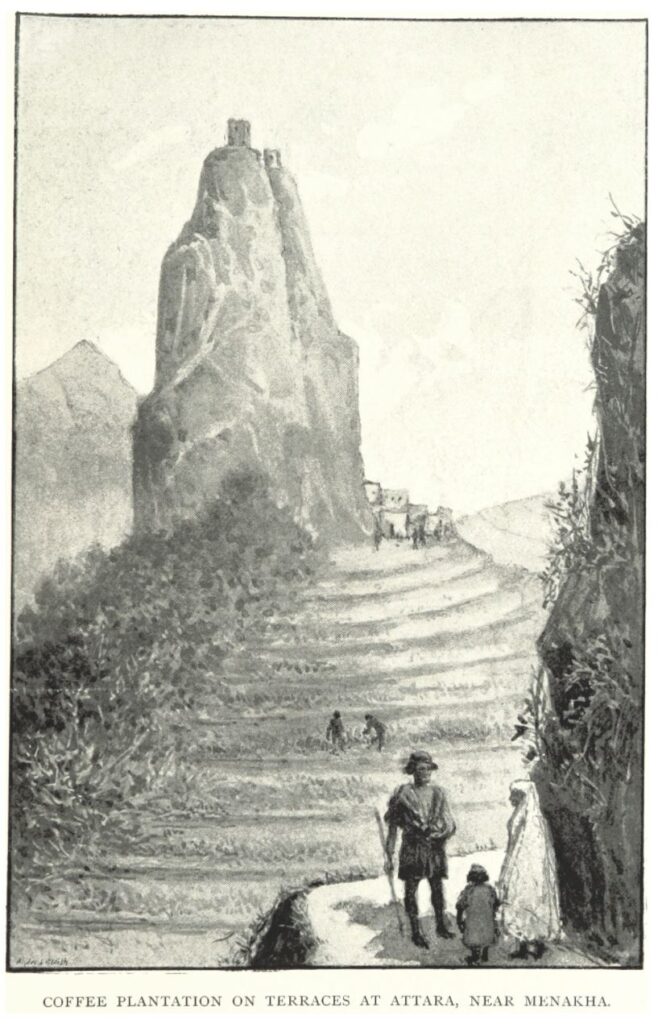
Although coffee beans originated in the mountainous regions of Western Ethiopia, the earliest written evidence of cultivation appeared in 12th century Yemen. There is, however, historical arguments that Ethiopia was the origin of cultivation as well as propagation, but no written records exist of that. Records for Yemenese cultivation do. This does tip the scale slightly in the favor of Yemen likely birthplace of coffee as a beverage we all consume today.
You may have heard the legend of the Ethiopian Kaldi and his goats, and how he discovered coffee by observing their behavior. There is another, less known legend involving Yemen, involving a Yemeni Sufi mystic priest/doctor named Sheikh Omar.
In one tale, the Kaldi story becomes Omar’s story instead. But in another tale, which is actually documented in period literature, Omar was exiled by his tribe, and became a hermit, living in a desert cave near Ousab Mountain. Starving, he noticed red berries he had never seen before on a nearby tree, and tried eating them. The fruit was minimal, and the seeds were hard and bitter.
He tried boiling the seeds, then put the seeds in a fire, noticing their enticing aroma. Eating the roasted seeds resulted in a still bitter experience, so he tossed them in a pot to boil. The result was the first brewed coffee with roasted beans.
Omar felt coffee’s effects. He headed back to his tribe, and shared the drink with his fellow priests. It helped them stay awake and focused, for their evening prayers. And coffee became what it was after that.
But how did coffee, native only to Ethiopia originally, even make its way to Yemen? It’s passage probably puts Omar’s story to doubt, or at least provides some indication that Ethiopians already knew coffee’s uses, though they did not know its export and commercial value.
Coffee was likely carried over the Red Sea by Ethiopian invaders on trips they made to Yemen. This means they knew it was a commodity and had purpose. Regardless, once coffee was rooted in Yemen, the plant became a foundational aspect of Islamic culture on the Arabian peninsula. It is the favorable growing conditions of the Yemenese highlands which attributes the name to coffee lover’s beloved species: coffea arabica.
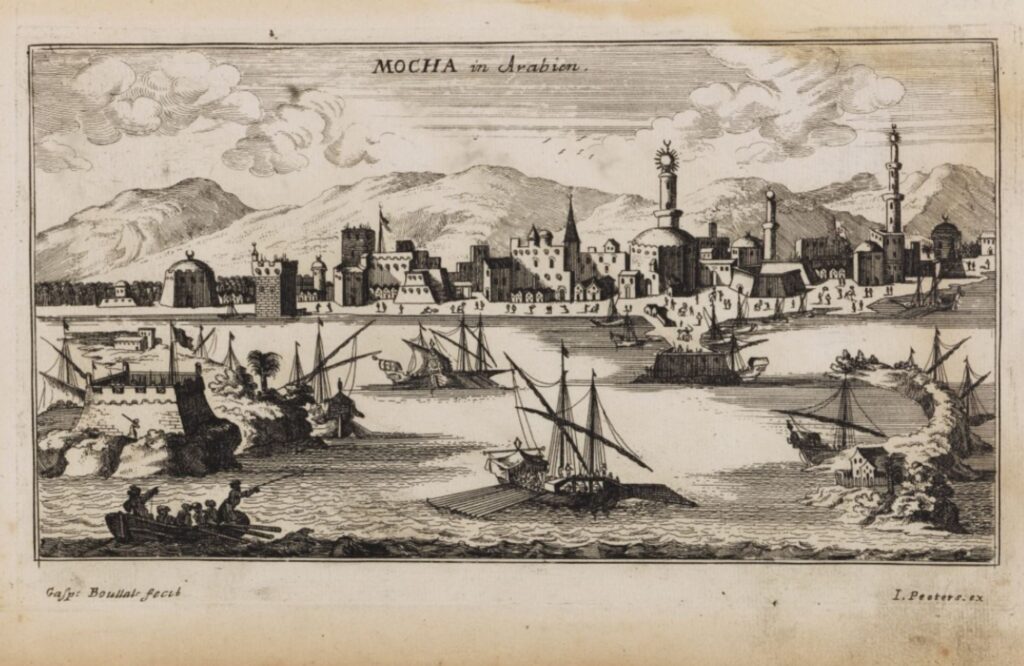
As Yemen coffee took root and demanded increased, the beans, with very rudimentary processing, made their way down the hills to a port on the Red Sea bearing another familiar name: Mocha. For centuries, the small city was the only gateway for coffee sold internationally. Tightly regulated by their Ottoman rulers, coffee beans were forbidden to leave Yemen without first being roasted to prevent germination.
The drink rapidly spread across Ottoman trade routes to Europe, where it was named mocha due to its similarities to chocolate. The mixing of nomenclatures continued, with Europeans attributing chocolate tasting notes to coffees of Yemenese origin from Mocha, and since it wasn’t enough, mixed real chocolate into the drink to call it a mocha.
Meanwhile coffee became the favored intoxicant of choice for the Islamic world. Named qahwa in Arabic, the same word for wine, the beverage was famously popularized by holy man Shaykh Shādhilī, who vouched for its abilities to focus on prayers and studies with less sleep.
Still fueled by Yemenese coffee, which traces 90% of the global genetic strains, coffee shops started appearing all around the Islamic world. Unsure whether the drink was spurring intellectual discourse or hedonistic endeavors, coffee wavered through phases of being banned and allowed by sultans.
Right up until the mid 1600s, the Ottoman Turks and Sultans of Yemen fiercely controlled the supply of coffee to the rest of the world, and were the only major producer of it, all of it coming out of the Port of Mocha.
Coffee was still roasted before it left Yemen, but some seedstock was smuggled out here and there. Some went to places like Paris, where it was grown in royal greenhouses (those examples of coffee were eventually carried to Central and South America, but that is another story). Some Yemeni coffee green beans made their way to India, which was the third country, after Ethiopia and Yemen, to begin growing coffee in cultivating numbers.
The Dutch managed to smuggle seeds and even a few trees, and eventually brought them to their foothold in the conquest world: Indonesia. They also saw the value of breaking the Ottoman stranglehold on coffee production, and made it priority for growing commercially.
Within a few generations, two “types” of coffee were known globally: Mocha, and Java. It would not be until the late 1800s that these were blended together in the world’s first coffee blend.
Today, with all the war and strife, Yemen is a very low-volume, yet highly prized coffee producer, the country’s exquisite growing conditions continue to produce some of the world’s most coveted beans. Though political unrest has made export incredibly difficult, there’s continued esteem for the region which put coffee on the map, and optimism for its future.

Ethan fell in love with coffee when he lived in Japan for 2 years. He worked in the coffee business as a roasters apprentice and barista until his late 20s, but never gave up a love for coffee. His favourite vacation is doing solo canoe trips in the interior of Ontario.